
Exercise · Core

Plank

  • Strength

Works: Core, shoulders and glutes.

Add to a routineUsed in 24 timer routines

How to do it
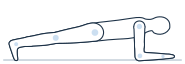
Line drawing of a plank: on the forearms and toes, body straight from head to heels.
  1. Lie face down, then come up onto your forearms with your elbows under your shoulders.
  2. Tuck your toes under and lift your body so it is straight from head to heels.
  3. Tighten your stomach as if bracing for a light poke, and squeeze your glutes.
  4. Hold, breathing normally. Look at the floor just in front of your hands.

Watch out for

Hips sagging, hips too high, and holding your breath.

Make it easier or harder

  1. 1Worktop plank: forearms on a kitchen worktop or sturdy table, feet stepped back.
  2. 2Knee-down plank: forearms on the floor and knees down, straight from knees to head.
  3. 3Plank.
  4. 4Leg-lift plank: lift one foot a few centimetres off the floor, hold, then swap. Keep your hips still.
  5. 5Long-lever plank: put your elbows a hand's width in front of your shoulders. The further forward, the harder.

Do the difficulty that suits you.

← Exercise A to Z

Safety and disclaimer

The workouts, exercise instructions and effort guide on this page are general information for adults. They are not tailored to you, they are not medical or professional advice, and they may not be suitable for you. They do not replace advice from a professional who knows you. Although exercise can be good for your health, all exercise carries some risk of injury.

Get advice from a doctor, physiotherapist or other qualified health professional before you start if:

  • you have a heart or lung condition, high blood pressure, diabetes or any other long-term condition
  • you have ever had chest pain, fainting or dizziness, with or without exercise
  • you have an injury, a joint or back problem, or pain when you move
  • you are pregnant or have had a baby in the last year
  • you have recently had an operation, or been ill
  • you take medicine that affects your heart rate, blood pressure or balance
  • you are new to exercise, or coming back after a long break
  • a doctor or other professional has told you to limit or avoid exercise
  • you have any other concern about your health

Stop straight away if you get chest pain or tightness, feel faint or dizzy, become unusually short of breath, feel your heart racing or beating irregularly, or feel sharp pain. Call 999, or your local emergency number, if you have chest pain or tightness, or if any of these does not settle quickly with rest.

Start at a level that feels comfortable and build up gradually. Clear the space around you, use a floor that is not slippery, and make sure any chair, step, bench or equipment is sturdy and will not move.

You choose whether to do these exercises and how hard to work, and you do them at your own risk. Read our full Medical Disclaimer.