

Welcome
Do you want to feel well, have more energy, a better mood and a slimmer waist?
Learn what metabolic health is, how to measure it, and how to improve it. Then put your 28 Day Plan into action.
A 28 day plan is achievable and it will get significant results. Within one to two weeks many people notice clothes become looser and a slimmer waist. Within two to three weeks my patients report feeling more alive, less hungry and a better mood.
The 28 Day Plan was originally created for patients in the NHS. The results were so impressive I decided it should be openly available so everyone can benefit. I hope you find it useful.
Campbell
Dr Campbell Murdoch (GP, UK)
Important
This is not medical advice or recommendation. It is only general and non-personalised information. It may not be suitable for your needs. It is only for people aged 18 years and over.
You must seek attention from an appropriate healthcare professional for all your medical needs.
All information and resources have been developed with great care and using up-to-date scientific literature. However, there is no guarantee the information provided is accurate or free from error.
By proceeding you acknowledge, understand, and agree with the above.
Download your 28 Day Plan resource pack, then watch the video and read the article below to learn about metabolic health and get the most from your 28 Day Plan. Browse recipes for 28 Day Plan friendly meal inspiration, and use the interval timer for the movement part of the plan.
Download your 28 Day Plan resource pack (PDF)
Tools and resources to help put the plan into action.
Learn more
Metabolic health is the engine for life
What metabolic health is, and what good and poor metabolic health look like.
Key points
- Metabolic health is the body's ability to store, release and use fuel while staying stable.
- Good metabolic health brings energy, a clearer mind and a better mood.
- Poor metabolic health causes fatigue, excess belly fat, and contributes to most modern diseases.
- Metabolic health can always be improved, often quickly.
Metabolic health affects us all. It is the foundation of our physical and mental health.
Metabolic health is the ability of the body to store, release and use fuel, whilst maintaining health and stability.
Good metabolic health means we are more likely to feel well and thrive. Conversely, poor metabolic health causes fatigue, excess belly fat, poor mental health and contributes to most modern diseases.
Fortunately, metabolic health can always be improved.
Good metabolic health
Good metabolic health makes people feel energised, awake, alert, clear thinking and hopeful.
In simple terms, good metabolic health means the engine for life is working well. It runs well and is less likely to break down. It can work harder and stay in good repair.
With good metabolic health people feel energised and are less likely to become unwell.
Poor metabolic health
Poor metabolic health means the body is at war with itself. The body will feel like a badly maintained car: it is a struggle to start, it runs poorly, and you are forever worried about it breaking down.
People report feeling tired, fed-up, and having no energy. They usually experience increased belly fat and sometimes skin tags. It can be difficult to lose weight or achieve a slimmer waist.
Most modern health conditions and diseases are related to poor metabolic health. This includes type 2 diabetes, prediabetes, high blood pressure, heart disease, stroke, many muscle and joint problems, fertility problems, many skin conditions, kidney disease, mental health problems, and many more.
Metabolic health can be improved
There is always hope. Metabolic health can always be improved, often by a lot.
Benefits can be noticed within a couple of days to weeks.
Looking after your metabolic health will mean you get the best from life. Keep reading to learn more about metabolic health and the specific actions you can take to get the results.
How the body works
A tour of the organs, cells and hormones behind metabolic health, and how insulin resistance develops.
Key points
- Metabolic health involves the whole body: gut, pancreas, liver, muscles, fat tissue and brain.
- Cells use tiny structures called mitochondria to turn food into energy; healthy mitochondria mean a healthier body.
- The body keeps blood glucose in a very narrow range, only about a teaspoon across all your blood.
- Insulin lowers blood glucose and stores fat. Insulin resistance, when cells stop responding to insulin, is the core of poor metabolic health.
Having a basic understanding of how the body works will make it much easier to understand how metabolic health can be improved.
Key body parts
Metabolic health involves the entire body, but there are some key organs — body parts — to know.
Digestive tract
The digestive tract, often known as the gut, starts at the mouth, moves on to the oesophagus, stomach, small intestine, large intestine, and then finishes at the anus. As food transits through the digestive tract, it is digested and the nutrients are absorbed into the blood.
Pancreas
The pancreas sits in the abdomen near to the stomach and liver. It releases digestive enzymes into the gut to help in the breakdown of food. The pancreas also releases hormones into the blood. One of these hormones is insulin which helps to keep blood sugar under control and to build the body’s fat stores.
Liver
The liver sits at the top right of the abdomen. It is the body’s main chemical processing factory. The liver’s duties include: removal and breakdown of harmful substances and the conversion of the food we eat into substances the body needs.
In addition, the liver makes and stores glucose sugar. It then releases that glucose into the blood when needed by the body. The liver also turns excess glucose into fat.
Circulatory system and heart
An average adult has about five litres (eight pints) of blood. This blood is held in a network of blood vessels including arteries and veins. The heart pumps the blood around the body.
There is also a blood system that goes directly from the gut to the liver. This means digested food can be processed by the liver before it is released into the wider body.
Muscles
There are muscles throughout the body. Muscles create movement.
Skeletal muscles include the large muscles of the body, such as on the arms, legs, and buttocks. These large muscles play an important role in removing excess glucose sugar from the blood. Big healthy muscles, that are used frequently, can store and use a lot of glucose.
Fat tissue
Fat tissue (adipose tissue) is the main storage site of fat in the body. There are two main types of adipose tissue: subcutaneous and visceral.
Subcutaneous adipose tissue can be considered the body’s healthy fat store. It is the fat that sits under the skin — the fat that can be seen on people. Metabolic health is helped by subcutaneous adipose tissue stores that are not overstuffed.
Visceral adipose tissue sits inside the abdomen. This fat sits in and on the internal organs. It is strongly linked to poor metabolic health and it is directly harmful to the body. A bigger waist circumference, or waistline, is a sign of more visceral fat.
Brain
The brain plays a central role in metabolic health. In the brain there is the hypothalamus; this can be considered the master controller of the body. It continuously monitors the internal environment of the body, such as the blood glucose level, and creates change throughout the body via the nervous system and hormone system.
The brain is also intricately involved in our behaviours, such as food choices.
Cells, mitochondria and metabolism
If we zoom in on organs we find cells and tiny structures called mitochondria.
Cells
The body is made from many trillions of cells. Cells can be thought of as living in a community and collaborating with each other to create organs. Cells specialise depending on the organ they are in, such as muscle cells and liver cells.
Inside cells there are tiny structures called organelles. Organelles work to keep the cell functioning.
Mitochondria
Mitochondria are one type of organelle. A main task of mitochondria is to create ATP. ATP is what cells use for energy.
Cells that are very metabolically active require a lot of energy, so they have more mitochondria. For example, a liver cell has thousands of mitochondria.
Health is very dependent on mitochondria. Healthy mitochondria = healthy body.
Metabolism
Inside cells trillions of chemical reactions are continuously happening. These chemical reactions are needed to convert the food we eat into molecules that are useful for the cells.
Molecules are constantly being broken down, rearranged, and built up. Cells also use chemical reactions to extract energy from the food we eat. Mitochondria play a central role in this.
Cells’ ability to access the energy they need, in a controlled manner, is essential for metabolic health. Too little energy will mean the cells cannot function. Too much energy can lead to stress on the mitochondria and cell.
The word used to describe all of these chemical reactions is metabolism.
Homeostasis and blood glucose
The body’s ability to maintain stability in an ever-changing world is essential for survival. Continuous adjustment is required. This adjustment and stability is known as homeostasis.
homeostasis, any self-regulating process by which biological systems tend to maintain stability while adjusting to conditions that are optimal for survival. If homeostasis is successful, life continues; if unsuccessful, disaster or death ensues. (Encyclopedia Britannica, 8 Apr. 2022)
There are multiple homeostatic processes in the body. For example: regulation of body temperature, water balance, and blood glucose.
All the body’s homeostatic processes are important for metabolic health. However, the ability to keep blood glucose stable is of central importance. The blood glucose level must be kept within a very narrow range.
Blood glucose homeostasis
Blood glucose homeostasis is essential for health. It is tightly controlled by the body to keep it at just the right level.
Where does the glucose in the blood come from? Glucose is a type of sugar that is found in nature. The glucose in blood can come from two sources: from plants and from our liver.
Plants make glucose sugar. The glucose can be joined into long chains — starch and fibre. Plants also make other sugars called fructose and sucrose (table sugar). When we eat foods containing sugar or starch the gut will break the food down into free glucose molecules. This glucose is then absorbed from the gut into the blood stream, resulting in a rise in the blood glucose level.
Glucose can also come from our liver. The liver can make and store glucose. If we haven’t eaten any sugar or starch for a short period, the liver will release glucose into the blood. Thus it is possible for humans to live without having to eat any sugar or starch.
How much glucose is in the blood? A normal blood glucose after fasting, such as first thing in the morning, is approximately 3.8–5.5 mmol/L (68–99 mg/dL). This is only 4 to 5 grammes (one teaspoon) of glucose in all the five litres (8 pints) of blood in the body. Too little or too much glucose in the blood can be extremely harmful — potentially fatal.
The body must ensure blood glucose homeostasis is maintained. To do this the body uses insulin to lower the blood glucose level.
Insulin and insulin resistance
Insulin is required to maintain blood glucose homeostasis. With poor metabolic health the body is insulin resistant. When there is insulin resistance more insulin is required to keep blood glucose under control.
Insulin
Insulin is a hormone. Hormones are the chemical messengers of the body. When released they travel in the blood and give instructions to other body parts and cells.
Insulin is made in the pancreas. When the pancreas senses there is too much glucose in the blood it releases insulin. The insulin is transported around the body and instructs cells — including the liver, muscles, and fat tissue — to reduce the amount of glucose in the blood. Insulin also tells the liver to stop making glucose.
In addition to lowering blood glucose, insulin also plays a very important role in building up the body’s fat stores. Insulin instructs the liver and fat tissue to make fat and to keep it in storage. So, insulin can also be thought of as a fat-storage hormone.
Insulin resistance
Insulin resistance is a core feature of poor metabolic health. Put simply, insulin resistance means the cells in the body are not “listening” or responding to insulin’s message. They are resisting it.
Cells become insulin resistant when they don’t want to take glucose in. This is usually because they are already filled with enough fuel, or they are unable to utilise the fuel. Insulin resistance is a cell’s attempt to protect itself from taking in excess fuel and becoming harmed.
Insulin resistance is a significant problem for blood glucose homeostasis. With insulin resistance the body has to fight harder to maintain just one teaspoon of glucose in the body’s five litres of blood. To achieve this the pancreas has to release larger amounts of insulin whenever sugar or starch are eaten. This large amount of insulin attempts to force the cells to take glucose out of the blood.
Insulin resistance combined with high blood insulin means the body is at war with itself. Cells are resisting and fighting for their own survival whilst the body is desperately trying to maintain a normal blood glucose.
In addition, the high blood insulin level also drives the body into fat storage mode. This happens via three mechanisms:
- Insulin instructs the body not to burn fat.
- Insulin instructs the liver and fat tissues to turn glucose into fat.
- Insulin instructs the fat stores to hold on to fat and for the fat stores to get bigger.
This battle of insulin resistance and high blood insulin is responsible for many aspects of poor metabolic health. It leads to difficulty in losing weight and all the associated conditions and diseases of poor metabolic health.
This would be a sad situation if it was not for the fact that it is possible to measure and improve insulin resistance and metabolic health.
How to measure metabolic health
The four simple measures that reveal insulin resistance, and their healthy ranges.
Key points
- Metabolic health is measured by looking for signs of insulin resistance.
- Four common measures: waist circumference, blood glucose, blood lipids (triglycerides and HDL-cholesterol), and blood pressure.
- A waist-to-height ratio under one half is a useful sign of good metabolic health.
- The IR Health Check form brings the measures together into a simple green, amber and red view.
Metabolic health can be measured by testing for insulin resistance. Insulin resistance causes many changes in the body. Here are some of the most commonly used measures:
- Waist circumference
- Blood glucose
- Blood lipids (fats): triglycerides and HDL-cholesterol
- Blood pressure
Measures of insulin resistance vary in different people. For example, insulin resistance will cause high blood pressure in some people whilst in others blood pressure may be perfect. However, by assessing all the measures it is possible to get a reasonable insight into an individual’s metabolic health.
Waist circumference
Waist circumference, or waistline, should be measured about 2 cm (1 inch) above the belly button. (The official medical method is to measure “halfway between the anterior-superior iliac spine and the lower rib”.) Trouser size is not waist circumference!
For consistency, it is best to measure waist circumference first thing in the morning.
Method: Take a deep breath in, then breathe out in a relaxed way, then take the measurement.
What is the healthy range?
What is deemed to be a healthy waist circumference varies by body type, sex, and ethnicity. So, instead of using just the waist measurement, the waist-to-height ratio provides a more reliable indicator of insulin resistance.
The waist-to-height ratio is simply your waist circumference divided by your height. It is generally accepted that, for health, a person’s waist circumference should be less than half their height. If waist circumference is more than half a person’s height they may have insulin resistance.
Tip: If you do not have a tape measure then a piece of string will do. Take a piece of string that is the same length as your height. Fold it in half, and see if it will fit around your waist.
Why does it increase with insulin resistance?
Insulin resistance and high blood insulin cause increased fat to build up inside and on the abdomen. This increases waist circumference.
Blood glucose
Glucose is the sugar that is in blood. It comes from food and it is also made in the liver. The body must control blood glucose very carefully.
For an accurate blood glucose reading it is very important for the blood glucose to be measured after a period of fasting. Fasting means no food or calorie-containing drinks should be consumed in the 8 to 10 hours prior to the test.
What is the healthy range?
A normal fasting blood glucose is between approximately 4 and 5.5 mmol/L (68–99 mg/dL). A fasting blood glucose level of 5.6 mmol/L (100 mg/dL) or over could indicate insulin resistance. A fasting blood glucose level above 7.0 mmol/L (126 mg/dL) could indicate diabetes.
Why does it increase with insulin resistance?
- The liver releases too much glucose into the blood.
- The body does not easily remove glucose from the blood.
Special considerations
- Fasting glucose can increase with exercise and stress. Where possible it is important to be mentally and physically relaxed for at least 2–3 hours prior to the test.
- A fasting blood glucose of 7.0 mmol/L (126 mg/dL) or more could indicate diabetes. People without a previous diagnosis of diabetes should arrange a more formal assessment with an appropriate medical professional. A fasting blood glucose of 11.0 mmol/L (198 mg/dL) or more in someone not known to have diabetes requires an urgent assessment with a medical professional.
- For people with type 1 diabetes the blood glucose level is not a useful indicator of insulin resistance. So, instead of using blood glucose an approximate equivalent is to use the most recent HbA1c measurement in the % units. (HbA1c is now usually given in the mmol/mol units, the % may need to be calculated from this.)
- For people with type 2 diabetes and on medication, insulin resistance exists whatever the blood glucose reading.
Blood lipids
Blood lipids are fats in the blood. They can be tested for with a blood test. A blood lipid test typically gives levels for triglycerides, HDL-cholesterol, LDL-cholesterol, and total cholesterol. It is triglycerides and HDL-cholesterol that are useful to give an indication of insulin resistance.
Triglycerides
Triglycerides are a type of fat in the blood. They are essential for the body and are a main source of fuel.
Triglycerides come directly from food, and they are also made in our body, especially by our liver. The liver turns any excess sugar into triglycerides. The main storage location of triglycerides is in our fat (adipose) tissue.
There should only be a small amount of triglyceride in our blood. The vast majority of triglycerides should be kept in storage in our fat tissue. It is normal for the amount of triglyceride in the blood to increase after eating fat. So, when measuring blood triglycerides to assess for insulin resistance it is important to fast prior to the test.
What is the healthy range? A lower triglyceride level indicates a healthier and less insulin-resistant state. A triglyceride level less than 1.7 mmol/L (150 mg/dL) is considered normal, and a level less than 1.3 mmol/L (115 mg/dL), or perhaps even lower, is ideal.
Why does it increase with insulin resistance?
- The liver is creating and releasing more triglycerides into the blood.
- The fat stores struggle to remove triglycerides from the blood.
- The fat stores constantly ‘leak’ fat into the blood.
Special considerations. A fasting triglyceride level of more than 5.6 mmol/L (496 mg/dL) is considered very high and should be discussed routinely with an appropriate healthcare professional. Blood triglycerides can be high for reasons other than insulin resistance, including individual genetic profile, alcohol, and pancreatitis.
HDL-cholesterol
HDL-cholesterol is the cholesterol that is part of an HDL particle in the blood. HDL stands for High Density Lipoprotein. HDL-cholesterol goes down with insulin resistance.
What is the healthy range? A higher HDL-cholesterol level is an indicator of better health. For males the HDL-cholesterol should be 1.0 mmol/L (40 mg/dL) or greater, and for females it should be 1.3 mmol/L (50 mg/dL) or greater.
Why does it decrease with insulin resistance? An increased insulin level reduces the production of HDL-cholesterol in the liver.
Blood pressure
Blood pressure is usually measured at the upper arm or wrist. It is very important to sit and relax when taking the measurement. When assessing blood pressure two measures are taken, the systolic blood pressure and the diastolic blood pressure.
Systolic blood pressure is the higher reading. It coincides with the heart squeezing and pumping blood out of the heart, sending a pressure wave through the arteries. Diastolic blood pressure is the lower reading and coincides with the heart relaxing between beats.
Blood pressure is usually reported as the systolic reading over the diastolic reading. For example, a systolic of 124 mmHg and a diastolic of 76 mmHg is described as ‘a blood pressure of 124 over 76’ and written as 124/76.
Many factors other than insulin resistance can affect blood pressure — mental stress or physical exertion can suddenly increase it. Therefore, measure blood pressure after a period (at least a few minutes) of calm, and it may be necessary to recheck a few times. However, insulin resistance is probably the most common cause of high blood pressure.
What is the healthy range?
- A blood pressure of less than 130/85 is considered normal.
- A blood pressure of less than 120/80 is considered ideal.
In healthcare blood pressure is categorised as:
- Ideal: systolic less than 120 and diastolic less than 80
- Normal: systolic less than 130 and diastolic less than 85
- High-normal: systolic 130–139 or diastolic 85–89
- Grade 1 hypertension: systolic 140–159 or diastolic 90–99
- Grade 2 hypertension: systolic 160–179 or diastolic 100–109
- Grade 3 hypertension: systolic above 179 or diastolic above 109
Why does it increase with insulin resistance?
- Insulin resistance of the small muscles that surround blood vessels prevents them relaxing. This causes the blood vessels to squeeze harder, increasing blood pressure.
- The kidneys play a central role in controlling blood pressure. A high insulin level alters how the kidneys function and raises blood pressure.
The IR Health Check
If you want to quickly understand what your measures mean you can use the IR (insulin resistance) Health Check form. This form makes it easy to assess your metabolic health. If all your measures are in the green it is likely your metabolic health is good. Whereas, if you have more measures in the amber or red it is likely you would benefit from improving your metabolic health.
Whenever possible, try to use all the IR Health Check measures to get a more complete view of your metabolic health.
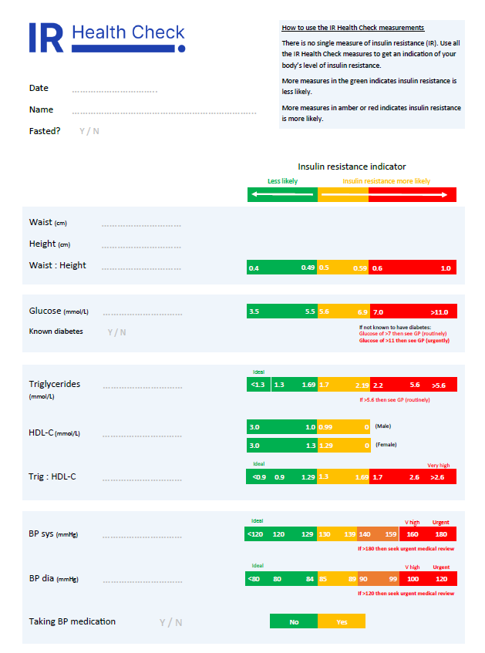
Download a PDF of the IR Health Check: international version · US version.
How to improve metabolic health
The four Health Foundations, and the changes that help or harm metabolic health.
Key points
- Four Health Foundations shape metabolic health: Nutrition, Movement, Sleep and Mindset.
- Nutrition: favour real food and adequate protein; limit sugar, ultra-processed foods and constant snacking.
- Movement and sleep: move regularly, challenge the big muscles, and protect 7 to 9 hours of good sleep.
- Mindset: connection, a sense of control, and helpful coping strategies all lower stress.
- Take a personalised approach, as there is no one size that fits all.
Metabolic health is affected by the Health Foundations: Nutrition, Movement, Sleep, and Mindset. Making improvements to these can make a significant and often rapid difference to health, wellbeing, and performance.
For each of the Health Foundations there are factors that worsen metabolic health, and factors that can improve it.
Use the Health Foundations and take a personalised approach. There is no one size fits all. What is best for you may change over time. The right approach should be enjoyable and get results. Each of the Health Foundations is summarised below. More in-depth information can be downloaded here.
Nutrition Health Foundation
Nutrition refers to what, when, and how much a person eats and drinks. It can have a significant impact on metabolic health. There is no one-size-fits-all and there is no good or bad. But there are helpful and unhelpful choices.
Factors that can worsen metabolic health
- Sugar. All types of added sugar, found in confectionary and sweet baked goods as well as many packaged ultra-processed foods. A large intake of fructose may be particularly problematic.
- Sugary drinks. These can provide a large amount of sugar that is rapidly absorbed from the gut — for example sugar-sweetened carbonated drinks and fruit juices.
- Ultra-processed foods. Significantly modified through factory processing, often with a long ingredients list. They may increase insulin resistance because the food matrix is destroyed, they often contain large amounts of sugar and refined carbohydrate, may be low in fibre and protein, may contain additives that interfere with gut bacteria, and they are easy to overeat.
- Refined carbohydrate. Starchy foods processed to remove fibre, vitamins and minerals — flour and flour-based products, white rice, many breakfast cereals. The starch is rapidly broken down to glucose which surges into the blood.
- Excessive fat. Natural fats in whole foods are well tolerated by most people, but a sudden large intake of fat creates a short-term increase in insulin resistance for 12–24 hours. If weight loss is desired some people will need to avoid excessive fat, particularly if eating more carbohydrate.
- Frequent snacking. Eating frequently provides a constant flow of food and frequent insulin release, leading to increased fat storage and insulin resistance.
Factors that can improve metabolic health
- Real food. Unprocessed or minimally processed food. More than half the food eaten in the UK is ultra-processed, so it is important to pay attention to what we eat.
- Adequate protein. Important for the body’s growth, maintenance and repair — and it helps create a feeling of satiety.
- Intermittent fasting. Also known as time-restricted eating. A longer period with no food allows insulin to fall, enabling utilisation of stored glucose and fat. A common example is 16:8 — all food eaten in an 8-hour window.
- Personalise carbohydrate. People who are very insulin resistant will be less tolerant to carbohydrate than people who are insulin sensitive and physically active.
- Adequate hydration. Dehydration may drive insulin resistance. Most people can trust their thirst, but some may need to focus on adequate fluid intake, perhaps two litres a day.
Movement Health Foundation
Movement includes physical activity or exercise, but daily general activity also counts. Lack of movement, and lack of challenge to the body’s muscles, leads to a gradual decline in metabolic health.
Factors that can worsen metabolic health
- Being sedentary. Not moving from the sitting or lying position whilst awake, for prolonged periods. (Sleep is not considered being sedentary.)
- Over-training. Physical exertion is generally good, but it is also a stressor. Excessive amounts of exercise over-challenge the body, and inadequate rest worsens this by not allowing repair and recovery.
Factors that can improve metabolic health
- Regular movement. It is beneficial to move for at least one or two minutes every hour or so. This does not have to be strenuous — even pottering around counts.
- Resistance activity. Challenging the big muscles provides space for excess glucose to go, and muscles release anti-inflammatory chemicals. Challenge the arms, legs and buttocks once or twice a week. Just a few minutes of intensive, muscle-fatiguing activity has a benefit.
- Aerobic activity. Cardiovascular exercise — movement of the big muscles with an increased heart rate, faster breathing, performed for a longer period.
Sleep Health Foundation
The quality and quantity of sleep is important for metabolic health. Sleep is essential for repair, recovery and restoration, and plays a central role in the control of hormones and blood glucose.
Factors that can worsen metabolic health
- Alcohol. Can significantly affect the quality and quantity of sleep and prevent the body moving into repair and recovery. Even small amounts can be detrimental to many.
- Late screen time. Distraction, mental stimulation, and blue light that can trick the brain into thinking it is daytime.
- Late caffeine. A stimulant found in coffee, tea, soft drinks and chocolate that interferes with sleep by blocking adenosine, an important promotor of sleep.
- Late eating. A large meal late in the evening can keep the fight-or-flight nervous system active, delaying refreshing sleep for 3–6 hours.
- Late intensive exercise. Can activate the sympathetic nervous system, preventing refreshing repair and recovery.
Factors that can improve metabolic health
- Adequate time. Most adults require 7 to 9 hours. Prioritise sleep, but don’t worry about it.
- Regular timing. Keeping to a regular bedtime and wake-up time helps with falling asleep.
- Pre-bed wind-down. Relaxing activities in the 30–60 minutes before bed, avoiding stressors.
- Morning routine. Daylight plays a role in adjusting the body clock and setting a sleep stopwatch.
Mindset Health Foundation
Mindset means the way of thinking, beliefs, and how someone may respond to information and events. Mindset can contribute to chronic stress, which increases insulin resistance. Conversely, a mindset that provides a sense of control and certainty can reduce stress.
Factors that can worsen metabolic health
- Being an outsider. Spending the majority of time with others who do not share your goals, purpose and values.
- Social isolation. Most people benefit from spending some time with others; isolation can lead to increased chronic stress.
- Disempowering focus. A constant focus on negative events you cannot control triggers a heightened threat response.
- Judgement of self. Negative criticism of who we are or how we look can create unhelpful thinking patterns and feelings of worthlessness.
Factors that can improve metabolic health
- Connect. Spending time with people who share your goals, purpose and values creates a sense of belonging and reduces stress.
- Influence. Focusing on the aspects of life you can influence gives the brain a greater sense of control, lowering the threat response.
- Notice. Noticing when your actions achieve a beneficial outcome provides a sense of achievement, which lowers the stress response.
- Helpful coping strategies. Unhelpful strategies (such as alcohol and drugs) may help in the moment but risk making tomorrow worse. Helpful strategies — like going for a walk or speaking with a friend — reduce stress without harming long-term health.
How to achieve your goals
How to turn a meaningful aspiration into daily actions and habits.
Key points
- Start with an aspiration that genuinely matters to you.
- Set Achievements: shorter checkpoints that feel exciting and reachable.
- Focus on daily Actions you can tick off, which become habits over time.
Success in achieving your goals starts with focusing on an important aspiration — what matters to you. Smaller checkpoints, or achievements, help create focus and energy for success. And it is daily actions and habits that make change happen.
Aspiration
Aspiration is the better future you can visualise. You may like to think of the big goal you want to reach, or it may be a direction you want to travel in. Most importantly, your aspiration needs to matter to you. The more you care, the more likely you are to succeed.
“In three months I am going to have lost 8 inches from my waist, improve my type 2 diabetes, and do a 5 km walk for charity.”
Achievements
Achievements are your checkpoints — shorter-term goals, ideally frequent (every few days, weeks or months). They give you something to focus on and work towards. They may be challenging but feel exciting and achievable. When you reach each checkpoint you feel good and are inspired to continue.
Actions
Actions are what you do today — the specific activities you can do every day, or most days, that will help you reach your Achievements. Actions should be specific enough to write down in a tick-list and mark off once done. By repeating actions every day they can, over time, develop into habits, which require much less effort to keep doing.
The 28 Day Plan
Two ways to put it into action over 28 days, and how to review your progress.
Key points
- Choose the 28 Day Rapid Results Plan or create your own Personal Health Plan.
- Both use simple daily actions you record on a chart.
- Meaningful improvement often begins within days and builds over a few weeks.
- Review at 7, 14, 21 and 28 days to notice progress and decide what comes next.
It is now time to put your metabolic health knowledge into action with a 28 day plan. You can choose the 28 Day Rapid Results Plan or create your own 28 Day Personal Health Plan.
Over 28 days metabolic health can dramatically improve. In fact, improvement starts to happen within days, with significant and lasting benefits noticed within a few weeks.
You have two plans to choose from:
- The 28 Day Rapid Results Plan. Ten specific actions you will do every day for 28 days. It will get results, but only follow this plan if it looks and feels right for you. If necessary, do speak with your healthcare professional before starting.
- Create your own 28 Day Personal Health Plan. Suitable for everyone, because you tailor the daily actions to your personal preferences and needs. Consider the Health Foundations and create specific daily actions you will take every day for 28 days. Go easy or hard — it is up to you.
Download and print the Metabolic Health 28 Day Plan resource pack. This has everything needed for the Rapid Results Plan or to create your Personal Health Plan.
Download your 28 Day Plan resource pack (PDF)
Reviewing your progress
Taking a brief moment to review your progress can significantly increase your success. Make sure you do this with a helpful mindset.
The Daily Review
Every day record your daily actions on your chart. At the end of each day, write down your total score. If you are doing the Rapid Results Plan your maximum daily score is 10 (the number of actions you successfully took). Take time to notice what went well each day.
The 7, 14 and 21 Day Reviews
At each 7 day interval review your progress. Ask yourself:
- What happened and what was my total score over the past 7 days?
- What has gone well?
- What will I focus on for the next 7 days?
The 28 Day Review
At the end of day 28 it is time to reflect and celebrate. Ask yourself:
- Looking at your chart, how many ticks have you achieved?
- What has gone well?
- How do you feel? Have you noticed more energy, a clear mind, or improvements in your mood?
- Have you noticed any changes in your body? Has your waistline changed? Is your body more toned?
- What daily actions are you going to keep doing?
- What will you do next? Repeat the same 28 day cycle, take a short break, or create a new 28 Day Personal Health Plan?
Reflections
A closing message from Dr Campbell Murdoch.
Metabolic health affects us all. It is the foundation of our physical and mental health.
I hope this article and the Metabolic Health 28 Day Plan has given you confidence in your health choices and helped you to achieve results that matter. Do share this resource with other people that may benefit from improved metabolic health and better physical and mental health.
Dr Campbell Murdoch